Multiple Select List Or Checkboxes Search
This step configures a comparison against either a text, number, boolean or date search column using the DataAssist Search server behavior. This is based on selecting Multiple select list or checkboxes when adding a search comparison in step 2 of the DataAssist Search Wizard: Define your DataAssist Search.
A single database column in either a numeric, bit, text, or date format is searched against. The value of the parameter used to make the comparison is determined by either selections in a specified multiple select list, or selections from a group of identically named checkboxes. Multiple selections pass multiple values for comparison, using an OR comparison that returns a record if any of the values exist.
Specify the appropriate database column type specific to the type of search parameter being used. The results returned depend on whether the selected column in a given record is an exact match of the parameter passed from the form element.
Note: The comparisons configured using this wizard are designed for standard implementations. Advanced search configurations can be achieved by either editing the application of the DataAssist Search server behavior applied to your results page by this wizard, or by applying this server behavior directly to your results page.
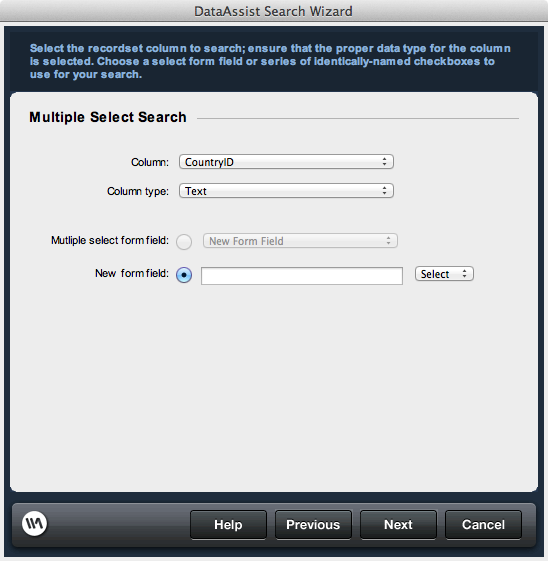
A single database column in either a numeric, bit, text, or date format is searched against. The value of the parameter used to make the comparison is determined by either selections in a specified multiple select list, or selections from a group of identically named checkboxes. Multiple selections pass multiple values for comparison, using an OR comparison that returns a record if any of the values exist.
Specify the appropriate database column type specific to the type of search parameter being used. The results returned depend on whether the selected column in a given record is an exact match of the parameter passed from the form element.
Note: The comparisons configured using this wizard are designed for standard implementations. Advanced search configurations can be achieved by either editing the application of the DataAssist Search server behavior applied to your results page by this wizard, or by applying this server behavior directly to your results page.
Columns
Specify a column type that matches the content of the database column to be searched against. This ensures that comparisons are made correctly based on the expected column format.Column: Select the database column to be searched against.
Column type: Select the column type that matches the type of search parameter to be passed from the form element(s) on the search page. Available options are:
Column type: Select the column type that matches the type of search parameter to be passed from the form element(s) on the search page. Available options are:
- Text
- Number/Boolean: Boolean is true or false value notated as 1 or 0 respectively. Typically captured as a bit field in the database.
- Date
Form fields
Specify the form element used to pass the parameter necessary to make the comparison. If you are using an existing search form (specified in Step 1 of the wizard, Search page seletion), you have the option of either adding a new form element or using an existing form element. If creating a new form, specify a unique name for the form field to identify and label it. Upon completing the wizard, you may use Dreamweaver to customize the search page specific to your needs.Multiple select form field: Specify the multiple select list or the name of the checkbox used to make the comparison. If using an existing search page and form, select if you wish to use an existing form element to make the comparison. All form elements contained in the form specified in step 2 of the wizard are available in the list. If performing a comparison against a series of checkboxes, they must be identically named
New form field: If creating a new form or creating a new search parameter in an existing form, specify the name of a new form element to add to the search form. Specify whether to use a Select or Check form element. When specifying a single check form element, only a single checkbox is added to the page. Upon completing the wizard, it is necessary to add additional checkboxes with the same name, but with different values to be passed as search comparisons. Be sure to label each checkbox to identify it appropriately to the end user.
Note: Do not use numbers as the first character when naming a form element. Options for select lists, as well as values associated to list entries, radio buttons, and checkboxes must be configured on the search page using Dreamweaver upon completing the wizard.
New form field: If creating a new form or creating a new search parameter in an existing form, specify the name of a new form element to add to the search form. Specify whether to use a Select or Check form element. When specifying a single check form element, only a single checkbox is added to the page. Upon completing the wizard, it is necessary to add additional checkboxes with the same name, but with different values to be passed as search comparisons. Be sure to label each checkbox to identify it appropriately to the end user.
Note: Do not use numbers as the first character when naming a form element. Options for select lists, as well as values associated to list entries, radio buttons, and checkboxes must be configured on the search page using Dreamweaver upon completing the wizard.